
Sinclair ZX Spectrum

Thrust
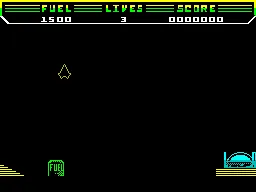
Thrust is a 1986 computer game programmed by Jeremy Smith (co-author of Exile) for the BBC Micro and published by Superior Software. The player's aim is to manoeuvre a spaceship by rotating and thrusting, as it flies over a two-dimensional landscape and through caverns. The gameplay of Thrust was heavily inspired by Atari's Gravitar.[citation needed] The aim is to pilot a spacecraft which must pick up a pod using a tractor beam and fly it into space. The ship and pod are subject to gravity and inertia, and being connected by a stiff rod can end up spinning around each other, out of control. Hitting the walls of the cave with either the ship or the pod results in death. Each planet has turrets which fire bullets at the ship, which can be destroyed with a single shot, and a reactor which powers the defence system of each planet. If the reactor is shot enough the turrets will cease firing for a short amount of time. Hitting the reactor with many bullets causes it to go critical and destroy the planet in 10 seconds - the ship must escape into space before this happens, with or without the pod (more points are gained if the pod is present). Fuel is needed to manœuvre the ship and can be collected with the tractor beam, if the ship runs out of fuel the whole game is over. A shield is also available, although when activated it uses fuel and the ship cannot shoot. Later levels have doors that are opened by shooting a panel. After all 6 levels have been completed the levels start again, but first with gravity reversed, then with the planet and walls invisible unless the shield is used, and finally with invisible walls and reverse gravity. After the 24th level is complete a message is displayed. Two more messages are available after completing the 48th and 72nd level, and from then on the 3rd message is repeated. On the BBC Micro implementation, the messages displayed are "Support Hotol", "Physics is fun" and "I love space". The realistic physics, pixel-perfect collision detection and a fearsome difficulty level were some of the main attractions of the game.
- Veröffentlichung
- December 31, 1985
- Entwickler
- Simon Clarke
- Publisher
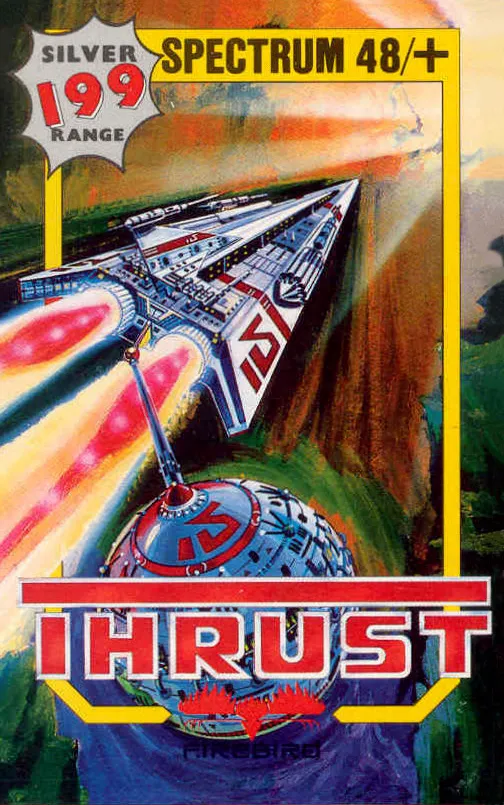
- Firebird Software
- Spieler
- 1
Über dieses Spiel
Thrust
Thrust is a 1986 computer game programmed by Jeremy Smith (co-author of Exile) for the BBC Micro and published by Superior Software. The player's aim is to manoeuvre a spaceship by rotating and thrusting, as it flies over a two-dimensional landscape and through caverns. The gameplay of Thrust was heavily inspired by Atari's Gravitar.[citation needed]
The aim is to pilot a spacecraft which must pick up a pod using a tractor beam and fly it into space. The ship and pod are subject to gravity and inertia, and being connected by a stiff rod can end up spinning around each other, out of control. Hitting the walls of the cave with either the ship or the pod results in death.
Each planet has turrets which fire bullets at the ship, which can be destroyed with a single shot, and a reactor which powers the defence system of each planet. If the reactor is shot enough the turrets will cease firing for a short amount of time. Hitting the reactor with many bullets causes it to go critical and destroy the planet in 10 seconds - the ship must escape into space before this happens, with or without the pod (more points are gained if the pod is present).
Fuel is needed to manœuvre the ship and can be collected with the tractor beam, if the ship runs out of fuel the whole game is over. A shield is also available, although when activated it uses fuel and the ship cannot shoot.
Later levels have doors that are opened by shooting a panel. After all 6 levels have been completed the levels start again, but first with gravity reversed, then with the planet and walls invisible unless the shield is used, and finally with invisible walls and reverse gravity. After the 24th level is complete a message is displayed. Two more messages are available after completing the 48th and 72nd level, and from then on the 3rd message is repeated. On the BBC Micro implementation, the messages displayed are "Support Hotol", "Physics is fun" and "I love space".
The realistic physics, pixel-perfect collision detection and a fearsome difficulty level were some of the main attractions of the game.
Genres
Modi
Studios und Mitwirkende
- Developer
- Simon Clarke
- Publisher
- Firebird Software
Regionale Veröffentlichungen
Veröffentlichung
Artwork-Galerie
6 images
Artwork hinzufügen
Help this listing look its best.
Share missing box backs, screenshots, clear logos, cartridges, discs, and other useful art. Nothing appears publicly until an administrator reviews it.