
Commodore Amiga

Simon the Sorcerer
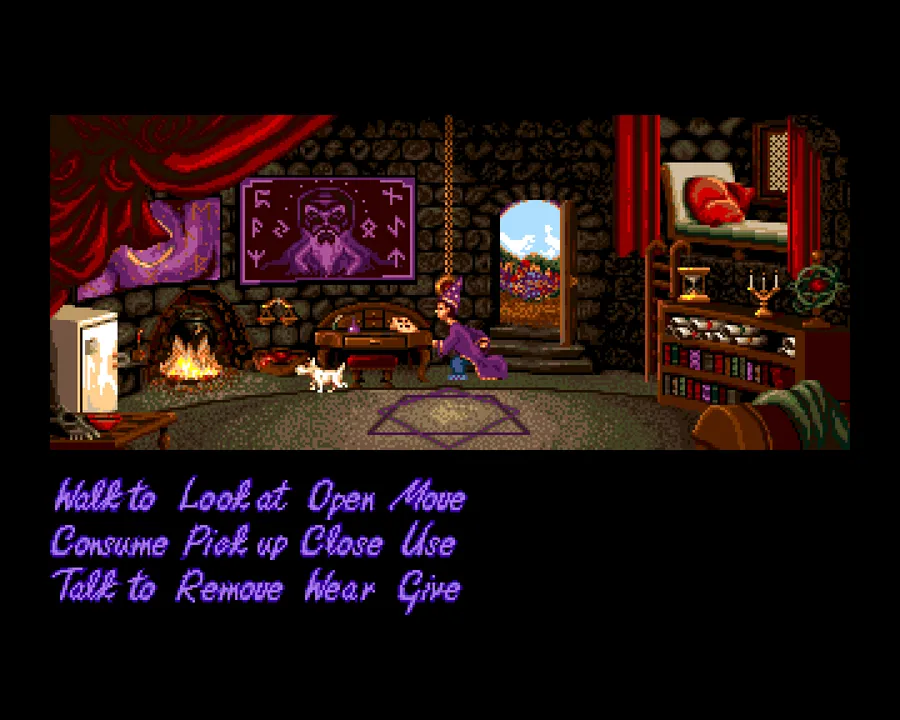
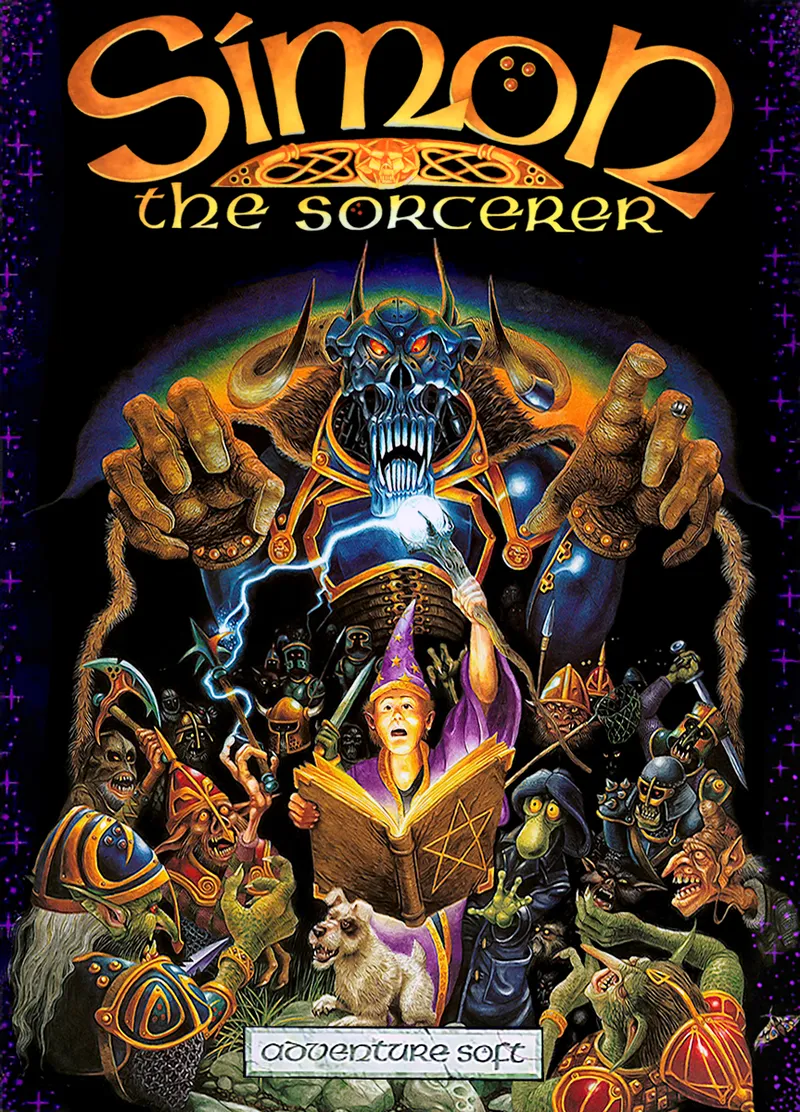
Simon is just an ordinary boy living in modern-day England. One day, his dog Chippy discovers a chest with a book inside, entitled Ye Olde Spellbooke. Without thinking too much, Simon throws the book on the floor; as a result, a portal opens, teleporting the boy and his dog into a fantasy world. Simon is promptly captured by goblins bent on cooking and eating him, but manages to escape. Soon he realizes that he must play the role of an apprentice sorcerer and rescue a benevolent wizard called Calypso from an evil one, aptly named Sordid. Simon the Sorcerer is a point-and-click adventure game very similar to contemporary LucasArts titles (in particular Monkey Island) in concept and gameplay. It features twelve verbs displayed on the screen at all times for interaction with the environment. Objects that can be interacted with are highlighted when the player hovers the mouse cursor over them. The puzzles are inventory-based: Simon will have to collect and carry a large amount of items in order to advance in the game. Almost every character comes with an extended dialogue tree to explore. Most of the conversation choices are used for a humorous effect and are not required to pursue. Like in LucasArts' adventures, it is impossible to get irrevocably stuck or die in Simon the Sorcerer. The game world consists of dozens of interconnected screens, most of which are accessible from the very beginning. Although there is usually only one way to solve the puzzles, the player can work on multiple tasks at once, and exploration occupies a large portion of the game. Whenever an important location is discovered, it is marked on the map for instant access, so that the player is not required to retrace his steps in order to revisit it. The game frequently parodies popular fairy tales and fantasy works and sometimes breaks the fourth wall as Simon directly talks to the player, acknowledging he is a character in a computer game.
- Release date
- December 31, 1992
- Developer
- Adventuresoft
- Publisher
- Adventuresoft
- Players
- 1
About this game
Simon the Sorcerer
Simon is just an ordinary boy living in modern-day England. One day, his dog Chippy discovers a chest with a book inside, entitled Ye Olde Spellbooke. Without thinking too much, Simon throws the book on the floor; as a result, a portal opens, teleporting the boy and his dog into a fantasy world. Simon is promptly captured by goblins bent on cooking and eating him, but manages to escape. Soon he realizes that he must play the role of an apprentice sorcerer and rescue a benevolent wizard called Calypso from an evil one, aptly named Sordid.
Simon the Sorcerer is a point-and-click adventure game very similar to contemporary LucasArts titles (in particular Monkey Island) in concept and gameplay. It features twelve verbs displayed on the screen at all times for interaction with the environment. Objects that can be interacted with are highlighted when the player hovers the mouse cursor over them. The puzzles are inventory-based: Simon will have to collect and carry a large amount of items in order to advance in the game. Almost every character comes with an extended dialogue tree to explore. Most of the conversation choices are used for a humorous effect and are not required to pursue.
Like in LucasArts' adventures, it is impossible to get irrevocably stuck or die in Simon the Sorcerer. The game world consists of dozens of interconnected screens, most of which are accessible from the very beginning. Although there is usually only one way to solve the puzzles, the player can work on multiple tasks at once, and exploration occupies a large portion of the game. Whenever an important location is discovered, it is marked on the map for instant access, so that the player is not required to retrace his steps in order to revisit it. The game frequently parodies popular fairy tales and fantasy works and sometimes breaks the fourth wall as Simon directly talks to the player, acknowledging he is a character in a computer game.
Genres
Modes
Studios and credits
- Developer
- Adventuresoft
- Publisher
- Adventuresoft
Regional releases
Release date
Artwork gallery
5 images
Add artwork
Help this listing look its best.
Share missing box backs, screenshots, clear logos, cartridges, discs, and other useful art. Nothing appears publicly until an administrator reviews it.