
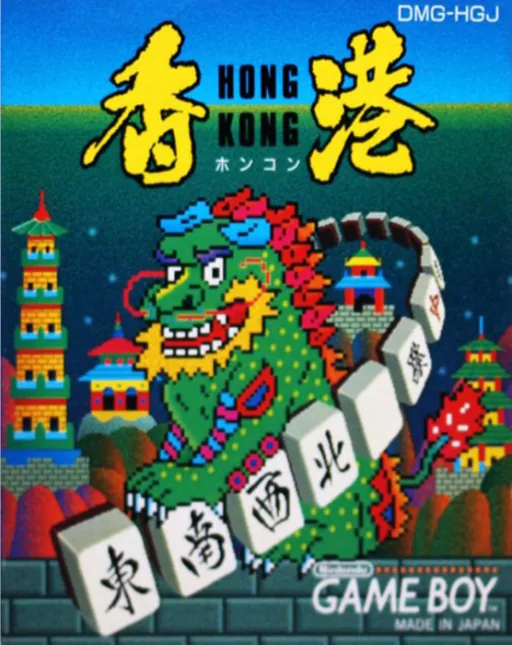
Nintendo Game Boy
Hong Kong
The first game to be produced as a coverdisk for Japanese Famicom magazine Famimaga, Hong Kong is a points-based variant of Mahjong Solitaire (a.k.a. Shanghai) that also plays a little bit like Jenga. Hong Kong, or Famimaga Disk Vol. 1 Hong Kong, is a Shanghai variant in which players must remove specified tiles from a pattern. The player can select which pattern (from pyramids and hourglasses to more complex designs) from which to draw tiles as well as inputting a three letter code which offers several thousand possible combinations of the tiles within that pattern. Rather than removing tiles in pairs on the edge of the pattern in order to access buried tiles, as is the norm in Shanghai, the player can select any tile on the board as long as it corresponds to the tile the game requests. However, points are scored based on how many other tiles surround the selected tile: A maximum of 320 points are awarded for tiles completely surrounded on all six sides by other tiles. Any tiles that aren't "standing" on at least one other tile will fall off the board causing a premature game over: players need to balance earning points by removing entrenched tiles while ensuring that no tile will fall off the table as a result of the removal. Because the game is not a true version of Shanghai it is named after another Chinese city - Hong Kong - instead.
- Data de lançamento
- March 23, 1990
Sobre este jogo
Hong Kong
The first game to be produced as a coverdisk for Japanese Famicom magazine Famimaga, Hong Kong is a points-based variant of Mahjong Solitaire (a.k.a. Shanghai) that also plays a little bit like Jenga.
Hong Kong, or Famimaga Disk Vol. 1 Hong Kong, is a Shanghai variant in which players must remove specified tiles from a pattern. The player can select which pattern (from pyramids and hourglasses to more complex designs) from which to draw tiles as well as inputting a three letter code which offers several thousand possible combinations of the tiles within that pattern.
Rather than removing tiles in pairs on the edge of the pattern in order to access buried tiles, as is the norm in Shanghai, the player can select any tile on the board as long as it corresponds to the tile the game requests. However, points are scored based on how many other tiles surround the selected tile: A maximum of 320 points are awarded for tiles completely surrounded on all six sides by other tiles. Any tiles that aren't "standing" on at least one other tile will fall off the board causing a premature game over: players need to balance earning points by removing entrenched tiles while ensuring that no tile will fall off the table as a result of the removal.
Because the game is not a true version of Shanghai it is named after another Chinese city - Hong Kong - instead.
Gêneros
Séries e coleções
Lançamentos regionais
Data de lançamento
Galeria de arte
4 images
Adicionar arte
Help this listing look its best.
Share missing box backs, screenshots, clear logos, cartridges, discs, and other useful art. Nothing appears publicly until an administrator reviews it.