
Sinclair ZX Spectrum

Spindizzy
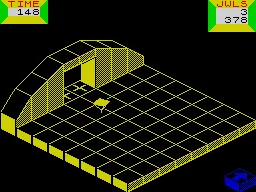
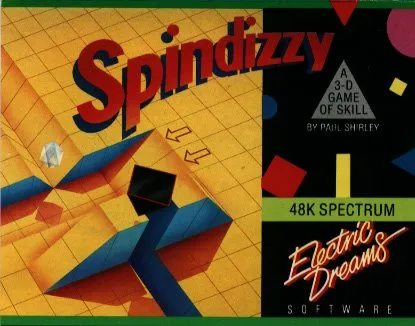
Spindizzy is an isometric computer game released for several 8-bit home computer formats in 1986 by Electric Dreams Software. It features action and puzzle game elements. Players must navigate a series of screens to explore a landscape suspended in a dimensional space. Development was headed by Paul Shirley, who drew inspiration from Ultimate Play the Game games that feature an isometric projection. The game was successful in the United Kingdom and was well received by the video game press. Reviewers praised its visuals and design, but criticized its audio. Similarities were drawn to Marble Madness, which was released in arcades two years earlier. Spindizzy was followed by a 1990s sequel titled Spindizzy Worlds. Spindizzy is an action and puzzle game played from an isometric perspective. Players can view the playing field from four angles, and rotate between them. The game takes place in a fictional landscape of interconnected stages suspended in a dimensional space. The player controls a probe called a Gyroscopic Environmental Reconnaissance And Land-Mapping Device (GERALD), via keyboard commands or a joystick. The craft is able to transform—and modify its mobility as a result—between three configurations: a ball, an inverted square pyramid, and a gyroscope. Players navigate the probe through the stages to explore the world within a time limit. The time limit can be extended by collecting power jewels scattered through the world and is decreased by falling off a stage. Stages feature ramps, corridors, and other obstacles that hinder the player from quickly traversing them. The game ends when time expires or the world is completely explored.[1][2]
- Fecha de lanzamiento
- December 31, 1985
- Desarrollador
- Electric Dreams Software
- Editora
- Electric Dreams Software
- Jugadores
- 1
Acerca de este juego
Spindizzy
Spindizzy is an isometric computer game released for several 8-bit home computer formats in 1986 by Electric Dreams Software. It features action and puzzle game elements. Players must navigate a series of screens to explore a landscape suspended in a dimensional space. Development was headed by Paul Shirley, who drew inspiration from Ultimate Play the Game games that feature an isometric projection.
The game was successful in the United Kingdom and was well received by the video game press. Reviewers praised its visuals and design, but criticized its audio. Similarities were drawn to Marble Madness, which was released in arcades two years earlier. Spindizzy was followed by a 1990s sequel titled Spindizzy Worlds.
Spindizzy is an action and puzzle game played from an isometric perspective. Players can view the playing field from four angles, and rotate between them. The game takes place in a fictional landscape of interconnected stages suspended in a dimensional space. The player controls a probe called a Gyroscopic Environmental Reconnaissance And Land-Mapping Device (GERALD), via keyboard commands or a joystick. The craft is able to transform—and modify its mobility as a result—between three configurations: a ball, an inverted square pyramid, and a gyroscope. Players navigate the probe through the stages to explore the world within a time limit. The time limit can be extended by collecting power jewels scattered through the world and is decreased by falling off a stage. Stages feature ramps, corridors, and other obstacles that hinder the player from quickly traversing them. The game ends when time expires or the world is completely explored.[1][2]
Géneros
Modos
Estudios y créditos
- Developer
- Electric Dreams Software
- Publisher
- Electric Dreams Software
Lanzamientos regionales
Fecha de lanzamiento
Galería
5 images
Añadir imagen
Help this listing look its best.
Share missing box backs, screenshots, clear logos, cartridges, discs, and other useful art. Nothing appears publicly until an administrator reviews it.