
Sega CD

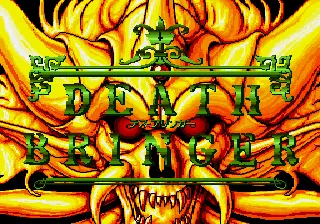
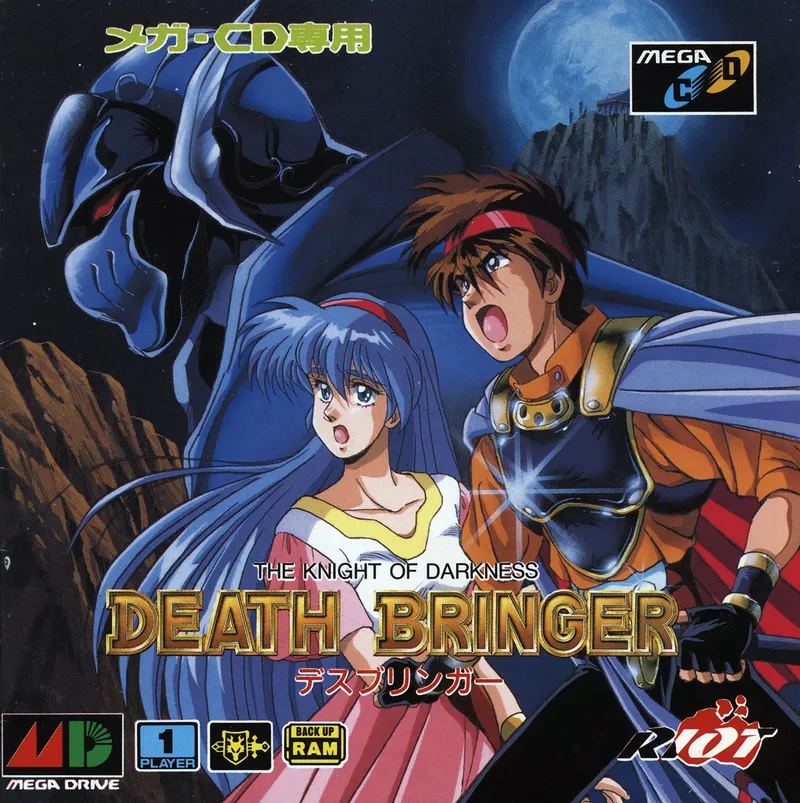
Death Bringer: Himerata Monshou: The Knight of Darkness
A powerful wizard, yearning for even more power, has found a sacred book that granted him command over armies of demons and men. Possessed by the desire to conquer and to destroy, he orders his armies to set cities on fire, massacring the citizens. But one nameless hero, the protagonist of this game, has to stand up against the evil. Leaving Soron, his home village, the hero embarks on a journey to find companions and to face together the forces of darkness. Despite being a Japanese game, Death Bringer is more similar to Western RPGs of the time than to their Japanese counterparts, even though it has anime-style character graphics. It is less event-oriented than Japanese games and focuses on exploration. The gameplay is somewhat similar to Pandora's RPG of the same name, even though the two games are unrelated. Both friendly and hostile areas are pseudo-3D, maze-like environments, like in Bard's Tale games. Enemy encounters, however, are handled more similarly to those of Ultima: the enemies appear on the exploration screen, and the battle initiates only if the player character approaches the enemy. The battles take place on a top-down field; the heroes and the enemies move around, but the player can't navigate the characters manually: it is only possible to issue commands such as "Attack", "Use Magic", etc. The game has a day/night cycle. Party members (up to three, excluding the hero) have to be sought out in various cities, rather then joining the hero for plot-related reasons.
- Date de sortie
- April 17, 1992
- Développeur
- Riot
- Éditeur
- Telenet Japan
- Joueurs
- 1
À propos de ce jeu
Death Bringer: Himerata Monshou: The Knight of Darkness
A powerful wizard, yearning for even more power, has found a sacred book that granted him command over armies of demons and men. Possessed by the desire to conquer and to destroy, he orders his armies to set cities on fire, massacring the citizens. But one nameless hero, the protagonist of this game, has to stand up against the evil. Leaving Soron, his home village, the hero embarks on a journey to find companions and to face together the forces of darkness.
Despite being a Japanese game, Death Bringer is more similar to Western RPGs of the time than to their Japanese counterparts, even though it has anime-style character graphics. It is less event-oriented than Japanese games and focuses on exploration. The gameplay is somewhat similar to Pandora's RPG of the same name, even though the two games are unrelated. Both friendly and hostile areas are pseudo-3D, maze-like environments, like in Bard's Tale games. Enemy encounters, however, are handled more similarly to those of Ultima: the enemies appear on the exploration screen, and the battle initiates only if the player character approaches the enemy. The battles take place on a top-down field; the heroes and the enemies move around, but the player can't navigate the characters manually: it is only possible to issue commands such as "Attack", "Use Magic", etc. The game has a day/night cycle. Party members (up to three, excluding the hero) have to be sought out in various cities, rather then joining the hero for plot-related reasons.
Genres
Modes
Studios et crédits
- Developer
- Riot
- Publisher
- Telenet Japan
Sorties régionales
Date de sortie
Galerie
4 images
Ajouter une image
Help this listing look its best.
Share missing box backs, screenshots, clear logos, cartridges, discs, and other useful art. Nothing appears publicly until an administrator reviews it.