
Commodore 64

D-Bug
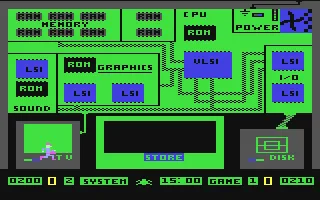
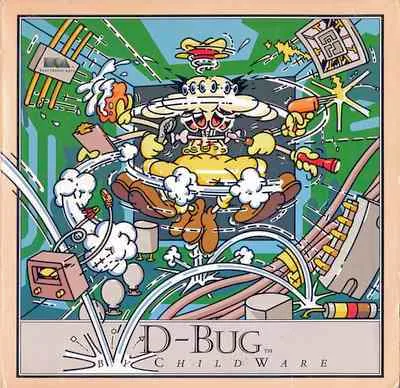
D-bug is an educational children's game involving debugging and fixing computers. D-Bug is a game within a game, with the player controlling the character Charlie Fix-it, who lives inside the player's computer fixing errors when they occur. At the beginning of each session, the human and computer opponent play a game of Gotcha!, where the goal is to capture all of your own pieces (butterfly or sailboat), while preventing the computer from capturing their own. Players can move one square at a time, and squares can not be repeated. The trick being to prevent the computer from gaining access to their own pieces. The game ends when no moves are remaining. Intermittently, the computer will break down, and the secondary game comes into play. The player then controls a character, who must diagnose and fix the computer's problem. The player determines the computer's issue by how the game stopped working, for instance if the Gotcha! graphics became corrupted, then the player knows the error is in the graphics processor. The player enters the computer, and must locate the buggy part, find a replacement, and put the working part in place. With the computer fixed, the game of Gotcha! may resume. A number of different errors can be diagnosed and fixed, and as the player successfully completes repairs, they automatically progress to a more difficult level.
- Date de sortie
- December 31, 1983
- Développeur
- ChildWare Corporation
- Éditeur
- Electronic Arts
- Joueurs
- 1
À propos de ce jeu
D-Bug
D-bug is an educational children's game involving debugging and fixing computers.
D-Bug is a game within a game, with the player controlling the character Charlie Fix-it, who lives inside the player's computer fixing errors when they occur. At the beginning of each session, the human and computer opponent play a game of Gotcha!, where the goal is to capture all of your own pieces (butterfly or sailboat), while preventing the computer from capturing their own. Players can move one square at a time, and squares can not be repeated. The trick being to prevent the computer from gaining access to their own pieces. The game ends when no moves are remaining.
Intermittently, the computer will break down, and the secondary game comes into play. The player then controls a character, who must diagnose and fix the computer's problem. The player determines the computer's issue by how the game stopped working, for instance if the Gotcha! graphics became corrupted, then the player knows the error is in the graphics processor. The player enters the computer, and must locate the buggy part, find a replacement, and put the working part in place. With the computer fixed, the game of Gotcha! may resume. A number of different errors can be diagnosed and fixed, and as the player successfully completes repairs, they automatically progress to a more difficult level.
Genres
Modes
Studios et crédits
- Developer
- ChildWare Corporation
- Publisher
- Electronic Arts
Sorties régionales
Date de sortie
Galerie
5 images
Ajouter une image
Help this listing look its best.
Share missing box backs, screenshots, clear logos, cartridges, discs, and other useful art. Nothing appears publicly until an administrator reviews it.