
Nintendo Famicom Disk System
Mahjong
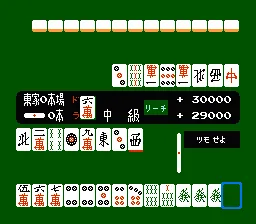
Mahjong is a classic Chinese game available in many different variations. Being a Japanese game, Mahjong for the Nintendo Famicom unsurprisingly revolves around the Japanese version of the game, also known as "Reach Mahjong" While originally a game for 4 players, Nintendo for some reason turned it into a two-player game when they released it for their console. This obviously has it's effect on the rules. The object of Mahjong is to form a complete hand of tiles before your opponent does so, and before the stack of tiles is empty. The first player to complete a hand is then awarded a number of points depending on how good his hand was (these points are subtracted from your opponent's points. Originally, there were rules to determine which opponents you got these points from, and how many they each had to give up, but since this game only has two players, these rules obviously do not apply here) and the person with the most points after 8 rounds is declared the winner. The game is played with small tiles in 5 different suits: Numbers, Circles, Bamboos, Winds and Dragons. The three first suits have 9 different tiles each, the Wind suit has 4, and the Dragon suit has 3. Each individual tile is repeated 4 times, for a total of 136 total tiles.
- Fecha de lanzamiento
- February 21, 1986
- Desarrollador
- Nintendo
- Editora
- Nintendo
- Jugadores
- 1-2
Acerca de este juego
Mahjong
Mahjong is a classic Chinese game available in many different variations. Being a Japanese game, Mahjong for the Nintendo Famicom unsurprisingly
revolves around the Japanese version of the game, also known as "Reach Mahjong" While originally a game for 4 players, Nintendo for some reason turned it into a two-player game when they released it for their console. This obviously has it's effect on the rules.
The object of Mahjong is to form a complete hand of tiles before your opponent does so, and before the stack of tiles is empty. The first player to complete a hand is then awarded a number of points depending on how good his hand was (these points are subtracted from your opponent's points. Originally, there were rules to determine which opponents you got these points from, and how many they each had to give up, but since this game only has two players, these rules obviously do not apply here) and the person with the most points after 8 rounds is declared the winner.
The game is played with small tiles in 5 different suits: Numbers, Circles, Bamboos, Winds and Dragons. The three first suits have 9 different tiles each,
the Wind suit has 4, and the Dragon suit has 3. Each individual tile is repeated 4 times, for a total of 136 total tiles.
Géneros
Modos
Estudios y créditos
- Developer
- Nintendo
- Publisher
- Nintendo
Lanzamientos regionales
Fecha de lanzamiento
Galería
6 images
Añadir imagen
Help this listing look its best.
Share missing box backs, screenshots, clear logos, cartridges, discs, and other useful art. Nothing appears publicly until an administrator reviews it.