
Amstrad CPC
10th Frame
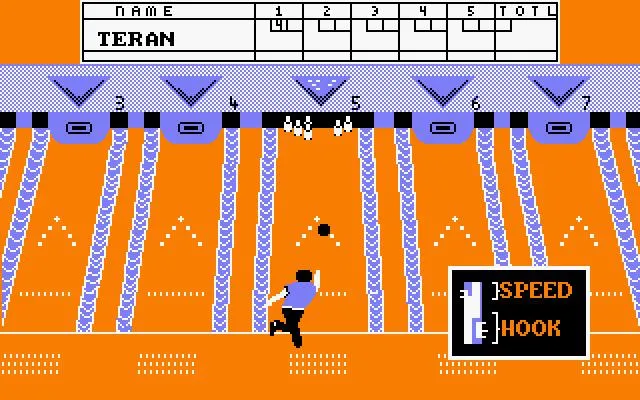
10th Frame is a ten-pin bowling simulation game created by Access Software in 1986, as a follow-up to the hugely successful Leaderboard golf game. Up to eight players could take part in open bowling or a tournament. There was a choice of 3 different difficulty levels—Kids (in which the ball always went straight), Amateur, and Professional. The scorecard for the current player was displayed above the lane. The player could move left or right on the lane before starting the run-up by holding fire. A target cursor could also be moved, by pushing up and then moving it left or right (pressing down returned control to moving the onscreen player's position). Once the fire button was held, a power meter similar to Leaderboard's was employed. The speed of the shot was determined by how long the button was held down. A small zone at the top determined if the player made an error, exaggerating any spin. When the meter started to descend on the right, it was stopped in the hook zone to determine how much hook/spin was applied - from straight at the top of the zone, to full hook at the bottom. Play was completed after the usual ten frames and any bonus balls. The animation used a similar sprite system to Leaderboard, and the falling pin physics were handled well.
- Data de lançamento
- December 31, 1985
- Desenvolvedor
- Paragon Programming
- Editora
- U.S. Gold Ltd.
- Jogadores
- 1-8
Sobre este jogo
10th Frame
10th Frame is a ten-pin bowling simulation game created by Access Software in 1986, as a follow-up to the hugely successful Leaderboard golf game. Up to eight players could take part in open bowling or a tournament. There was a choice of 3 different difficulty levels—Kids (in which the ball always went straight), Amateur, and Professional.
The scorecard for the current player was displayed above the lane. The player could move left or right on the lane before starting the run-up by holding fire. A target cursor could also be moved, by pushing up and then moving it left or right (pressing down returned control to moving the onscreen player's position). Once the fire button was held, a power meter similar to Leaderboard's was employed. The speed of the shot was determined by how long the button was held down. A small zone at the top determined if the player made an error, exaggerating any spin. When the meter started to descend on the right, it was stopped in the hook zone to determine how much hook/spin was applied - from straight at the top of the zone, to full hook at the bottom. Play was completed after the usual ten frames and any bonus balls. The animation used a similar sprite system to Leaderboard, and the falling pin physics were handled well.
Gêneros
Modos
Estúdios e créditos
- Developer
- Paragon Programming
- Publisher
- U.S. Gold Ltd.
Lançamentos regionais
Data de lançamento
Galeria de arte
6 images
Adicionar arte
Help this listing look its best.
Share missing box backs, screenshots, clear logos, cartridges, discs, and other useful art. Nothing appears publicly until an administrator reviews it.