
Amstrad CPC

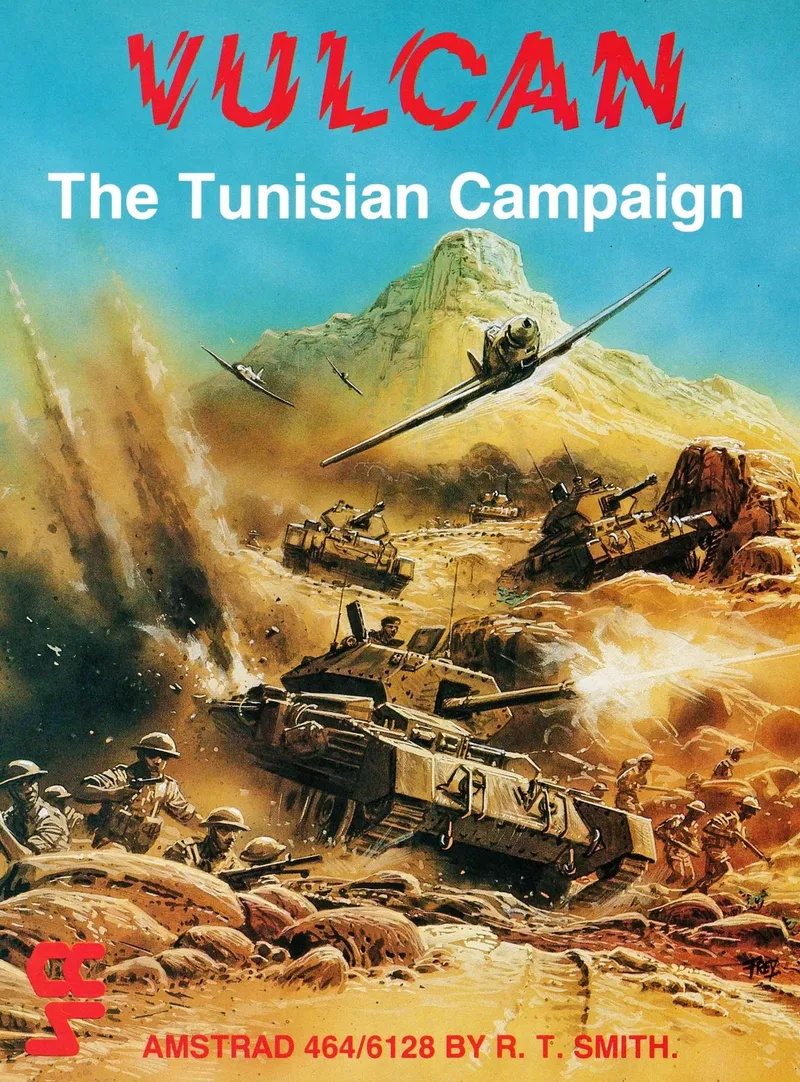
Vulcan: The Tunisian Campaign
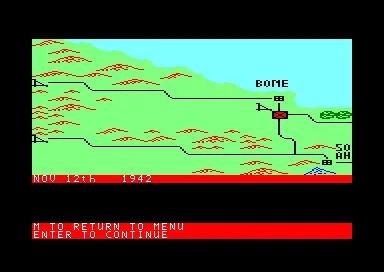
Vulcan is the final entry in R. T. Smith's World War II trilogy, following Arnhem and Desert Rats. It simulates the Tunisian Campaign in 1942-43 from the arrival of the 'Torch' Task Force and their race for Tunis, to the final battle of 'Operation Vulcan'. There are 5 armies (3 Allied & 2 Axis) and 5 scenarios, including the battles of Kasserine and Mareth. Each scenario has several pre-conditions to start from, which include Axis control Malta, Axis capture Bone, DAK (Deutsches Afrika Korps) destroyed, Desert armies late, and French neutrality. The gameplay is shown on scrolling maps via turns. Each player selects the units and gives them orders. Units move on the grid of rectangular cells. Landscape objects influence on the movement. For example, mountainous terrain allows hidden movement, or river blocks the way. Air attack phase is possible between turns. The game comes with detailed instruction booklet and includes historical notes on the campaign, maps and photographs. Two players representing Allied and Axis may be computer or human.
- Date de sortie
- December 31, 1986
- Développeur
- CCS
- Éditeur
- CCS
- Joueurs
- 1-2
À propos de ce jeu
Vulcan: The Tunisian Campaign
Vulcan is the final entry in R. T. Smith's World War II trilogy, following Arnhem and Desert Rats. It simulates the Tunisian Campaign in 1942-43 from the arrival of the 'Torch' Task Force and their race for Tunis, to the final battle of 'Operation Vulcan'. There are 5 armies (3 Allied & 2 Axis) and 5 scenarios, including the battles of Kasserine and Mareth. Each scenario has several pre-conditions to start from, which include Axis control Malta, Axis capture Bone, DAK (Deutsches Afrika Korps) destroyed, Desert armies late, and French neutrality.
The gameplay is shown on scrolling maps via turns. Each player selects the units and gives them orders. Units move on the grid of rectangular cells. Landscape objects influence on the movement. For example, mountainous terrain allows hidden movement, or river blocks the way. Air attack phase is possible between turns.
The game comes with detailed instruction booklet and includes historical notes on the campaign, maps and photographs. Two players representing Allied and Axis may be computer or human.
Genres
Modes
Studios et crédits
- Developer
- CCS
- Publisher
- CCS
Sorties régionales
Date de sortie
Galerie
6 images
Ajouter une image
Help this listing look its best.
Share missing box backs, screenshots, clear logos, cartridges, discs, and other useful art. Nothing appears publicly until an administrator reviews it.