
Atari ST

Klax
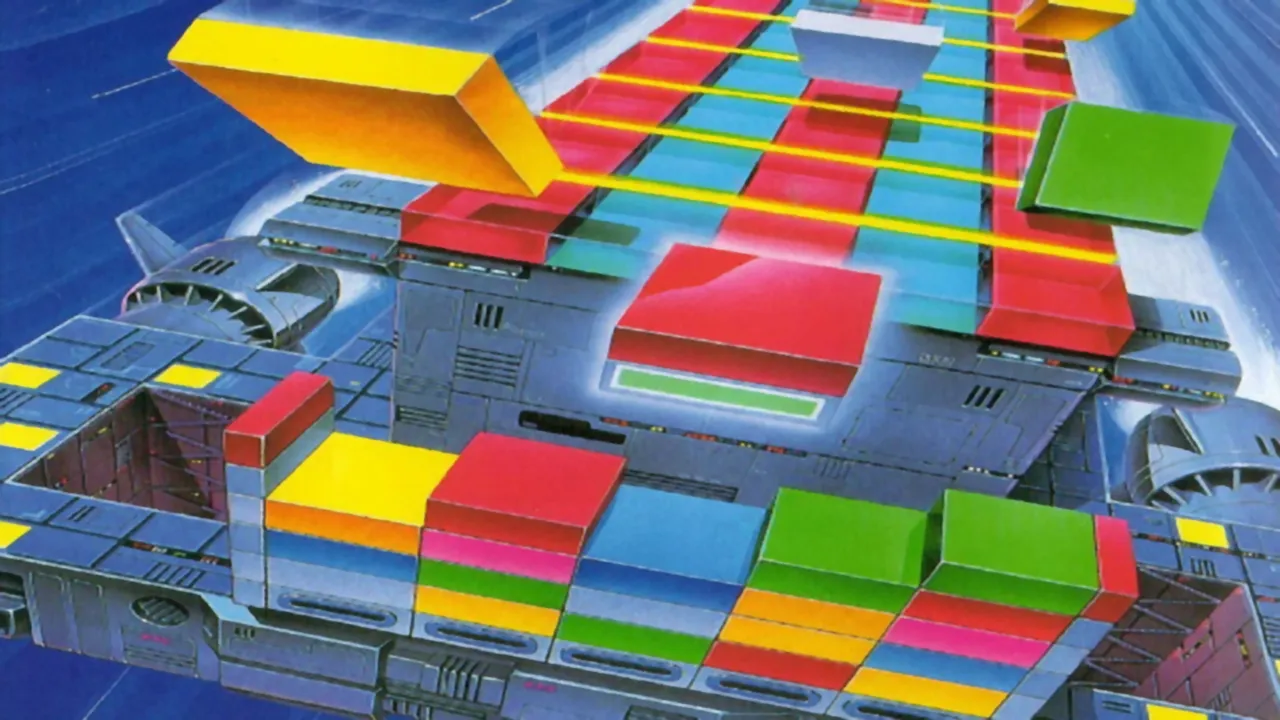
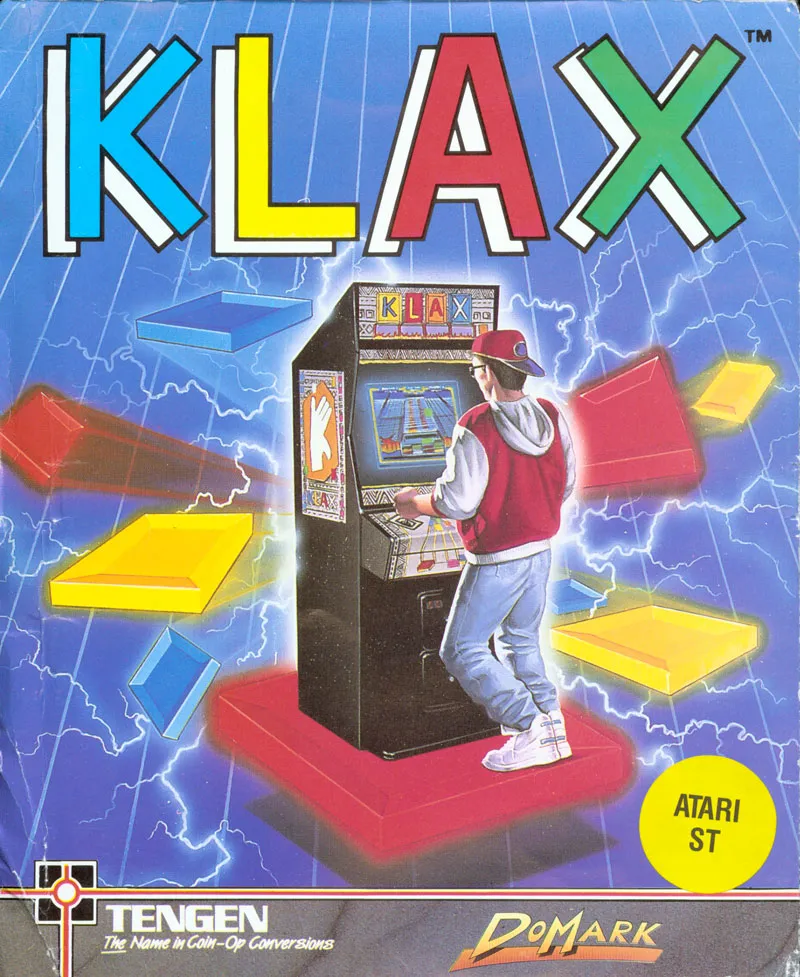
Klax is a 1989 computer puzzle game designed by Dave Akers and Mark Stephen Pierce. The object is to line up colored blocks into rows of similar colors to make them disappear, to which the object of Columns is similar. Klax features a conveyor belt at the top of the screen. It constantly rolls toward the playing area, delivering a steady supply of blocks. The player controls a small device which sits at the interface between the conveyor belt and the playing area, which can be moved left and right to catch the blocks and deposit them either in the playing area (which can hold 25 blocks in a 5X5 arrangement) or push them back up the conveyor belt. The device can hold up to five blocks. An uncaught block is considered a "drop". A flashing block can be used as a wildcard on any colour. In the playing area, blocks can be eliminated by arranging three or more of the same color into a continuous line, known as a "Klax." The line may be horizontal, vertical, or diagonal. A multiple grouping (e.g., one vertical and horizontal) counts as multiple Klaxes, as does Klaxes of four same-colored blocks (two Klaxes) or five same-colored blocks (three Klaxes). Once the goal is reached, bonus points are awarded for remaining blocks on the conveyor belt and device, and empty spaces in the bin (also, on levels where a certain point total is required, points in excess of the required amount are counted both in the scoring and as bonus points).[citation needed] Klax consists of 100 levels grouped into blocks of five. At the beginning of the game and after each fifth level (levels divisible by five, except for Levels 95 and 100), a player can choose to skip five or ten levels. Skipping levels gives bonus points and a higher drop allowance. The game ends when the player either exhausts their drop allowance, fills up their playing area, or finishes level 100
- Data de lançamento
- December 31, 1989
- Desenvolvedor
- Teque Software Development
- Editora
- Domark
- Jogadores
- 1
Sobre este jogo
Klax
Klax is a 1989 computer puzzle game designed by Dave Akers and Mark Stephen Pierce. The object is to line up colored blocks into rows of similar colors to make them disappear, to which the object of Columns is similar.
Klax features a conveyor belt at the top of the screen. It constantly rolls toward the playing area, delivering a steady supply of blocks. The player controls a small device which sits at the interface between the conveyor belt and the playing area, which can be moved left and right to catch the blocks and deposit them either in the playing area (which can hold 25 blocks in a 5X5 arrangement) or push them back up the conveyor belt. The device can hold up to five blocks. An uncaught block is considered a "drop". A flashing block can be used as a wildcard on any colour. In the playing area, blocks can be eliminated by arranging three or more of the same color into a continuous line, known as a "Klax." The line may be horizontal, vertical, or diagonal. A multiple grouping (e.g., one vertical and horizontal) counts as multiple Klaxes, as does Klaxes of four same-colored blocks (two Klaxes) or five same-colored blocks (three Klaxes). Once the goal is reached, bonus points are awarded for remaining blocks on the conveyor belt and device, and empty spaces in the bin (also, on levels where a certain point total is required, points in excess of the required amount are counted both in the scoring and as bonus points).[citation needed]
Klax consists of 100 levels grouped into blocks of five. At the beginning of the game and after each fifth level (levels divisible by five, except for Levels 95 and 100), a player can choose to skip five or ten levels. Skipping levels gives bonus points and a higher drop allowance. The game ends when the player either exhausts their drop allowance, fills up their playing area, or finishes level 100
Gêneros
Modos
Estúdios e créditos
- Developer
- Teque Software Development
- Publisher
- Domark
Lançamentos regionais
Data de lançamento
Galeria de arte
6 images
Adicionar arte
Help this listing look its best.
Share missing box backs, screenshots, clear logos, cartridges, discs, and other useful art. Nothing appears publicly until an administrator reviews it.